
Curb and Gutter in Fort Collins and Northern Colorado
A curb and gutter does two jobs at the same time, and homeowners usually only ever hear about one of them. The first is structural. It holds the edge of a slab or a paved area so the ground beside it cannot wash out and leave the concrete unsupported from the side. Edges go before middles do. A driveway breaking up along one side is often not a bad slab at all. It is a slab whose edge had nothing next to it holding the ground in place.
The second job is water. The pan at the base of the curb is a shallow channel, and it gives snowmelt and rain a defined path to follow instead of letting it run wherever your ground happens to fall. That is the part nobody expects. A curb is a line you can see. What it does to water stays invisible until the spring you notice one corner of the property still soft days after everything else has dried.
ECB Concrete LLC pours residential concrete across Northern Colorado, and we are a father and son operation working out of Fort Collins. This is the most specialized page on our site, and we wrote it assuming you have not already decided you want the work. Most people arrive here sideways. They were pricing a drive, or a turnaround, or the paved strip beside the garage, and somebody used the phrase.
So the page earns the explanation before it asks for anything. What follows is what those two jobs actually require on a private lot: the profiles, the pan, the fall along the run, the tie-ins, and what a curve changes about all of it.
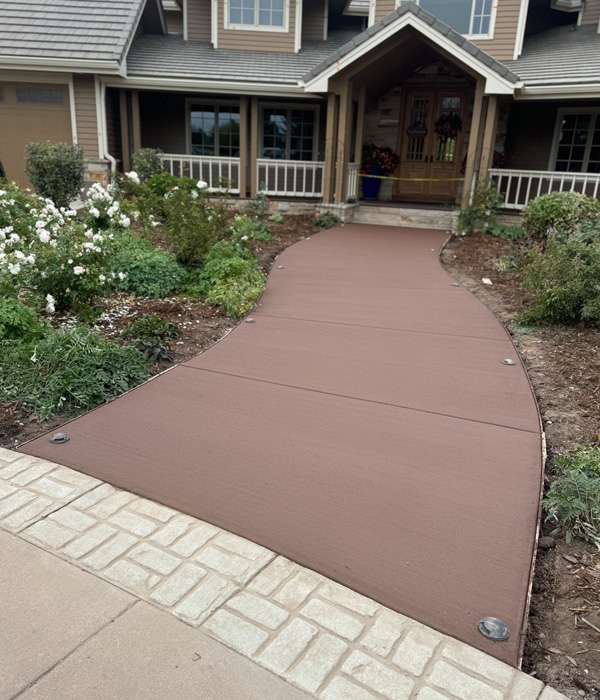
What a curb and gutter project includes
A curb and gutter run is one continuous piece of work made of two shapes: the face of the curb standing up, and the flat pan lying beside it. Here is what we settle with you before anything gets formed.
- The curb profile and its height. A barrier profile stands up square and stops a wheel, which is what you want along a turnaround or anywhere a vehicle could roll off the paved area. A rolled or mountable profile rises on a curve so a tire can climb it, which suits a drive border where somebody occasionally needs to cross the line with a trailer or a mower. Height is a separate decision from profile. A taller face holds back more water and takes more of a hit. A lower one is easier to cross and sits lighter against the house.
- Gutter pan width. The pan is the flat section that carries water along the base of the curb, and its width sets how much it can move before water climbs the lip and spills over. A narrow pan handles a short run picking up off one small area. A longer run collecting off a broad paved surface wants a wider pan, because everything upstream of the low end arrives there eventually.
- The tie-in where the curb meets a driveway or a paved edge. This joint is the whole structural job in one detail, and it takes most of the thinking. The curb has to sit tight against the existing edge with no gap for water to work into, and the two pieces still have to move seasonally without prying at each other. We detail that joint at the estimate rather than on pour day.
- Fall along the run, and where the water gets delivered. Water follows the pan, so the pan has to drop steadily from the high end to the low end with no flat spots and no reversals in between. The far end matters just as much. Water leaving the run has to arrive somewhere on your own property that can absorb it, well clear of the house and the slab, and we work that out before a single grade stake goes in.
- Straight runs against radius and curved work. A straight run forms fast on rigid stock and holds its line by itself. A curve is a different craft. Forms get bent or built to the radius, the profile has to stay identical the whole way around while the inside and outside faces cover different distances, and the fall has to keep dropping through the turn. Curves are where a curb either reads as deliberate or reads as improvised.
- Transitions at aprons and openings. A run rarely goes end to end uninterrupted. It steps down where a walk crosses it, breaks open where a vehicle enters, and ties into an apron where the paved area begins. Each is a detailed transition carrying its own grade, and each is a spot where water will find a way out if the shape is even slightly wrong.
What does a curb and gutter project cost?
A curb and gutter number comes off 3 measurements: total linear feet, how much of that run curves, and how much forming the profile takes. We publish no prices, because a 40 foot straight border and a 40 foot run wrapping a turnaround are the same footage and nowhere near the same work. Here is what actually moves it.
| What Drives the Number | Why It Moves | What We Do About It |
| Total length of the run | Linear footage is the base measurement everything else scales against. Forms, concrete, and finishing time all track it, and a curb has no economy in the middle the way a slab does, because a curb is all edge. | We measure the run on the ground rather than off a sketch, and we quote by the foot so you can see straight away what shortening or extending it does. |
| Straight run against radius work | A straight form is set and staked. A radius has to be built to the curve, and the crew works the profile around it by hand while holding the face and the pan identical the whole way. The same footage in curves takes considerably longer. | We split the quote into straight footage and curved footage instead of averaging them, so a design change shows up as a number you can see rather than a conversation after the fact. |
| Curb height and the profile you pick | A taller face is more concrete and more forming. A rolled profile takes more shaping by hand than a square one. Neither is automatically right, and the wrong choice costs twice, once to pour and once to live with. | We ask what has to cross the line and what has to be stopped by it, then recommend a profile and a height against that answer instead of defaulting to one. |
| Tie-ins to existing slabs | Every place the run meets concrete that is already there is a joint somebody has to get right, and existing concrete is never exactly where a drawing says it is. More tie-ins means more layout and more hand work. | We count the tie-ins during the site visit and state how many there are, so it is a visible line rather than an assumption inside a total. |
| Removing an existing edge | An old curb or a broken border comes out and goes somewhere before the new run can be formed. Its length, how thick it is, and how tight the access is for a truck all move that line. | We quote removal on its own line, so you always know which part of the number is demolition. |
| Correcting the fall the water has to follow | When the ground the run has to follow does not currently drop the way water needs to go, the base under the run gets re-cut so the fall is built in. That is genuine excavation, and it is often the reason the previous edge failed. | We shoot grades along the whole length before quoting, so the correction sits inside the original number instead of turning up later. |
The row doing the most work on your project is usually one of the bottom three, and none of them show up in a footage figure. Holding two quotes for the same run side by side, compare curved footage, tie-in count, and what each says about grade.
How we run a curb and gutter project
The order below is fixed, because every step sets up the one after it. A curb and gutter run leaves almost no room to correct an earlier mistake later, since the shape is the finished product and there is no surface to work on top of.
- Walk the run and shoot the grades. We start at the water, not the concrete. We walk the full length with a level, find the existing high and low points, and work out where water goes today and where it needs to go instead. When those two do not match, we know it here, before anyone has quoted a foot of curb.
- Lay out the line and the radii. The run gets marked on the ground, curves included, with the actual radius pinned rather than eyeballed. This is the step where you stand on your own site and look at it. A curve that reads fine on paper can be too tight to drive once it is staked, and moving a stake costs nothing.
- Remove the existing edge where there is one. An old curb, a broken border, or a strip of failed concrete along the edge comes out and gets hauled off. We do not form new work against something already coming apart, because the new run would inherit that problem at the joint.
- Cut and compact the base under the run. We cut to depth along the line, take out soft and organic material, and compact base in lifts. A curb is narrow and tall for its footprint, which makes it less forgiving than a wide slab about what sits underneath. Ground that settles under one section takes that section out of line with the rest of the run.
- Set forms to the profile and the slope. Forms go up for both faces of the curb and the outer edge of the pan, staked to finished elevations. The fall gets built into the formwork right here. Slope on a run like this is set by the forms, and no amount of trowel work invents it afterward.
- Place 4000 PSI concrete. Concrete is placed along the run and consolidated so there are no voids in the face or under the lip. We pour a run continuously wherever the length allows, because a cold joint in the middle of a curb is a line you will be looking at for as long as the curb is there.
- Shape and finish the curb face and the pan. The face is shaped to the profile and the pan is floated flat and true, then both get a broom finish for traction. This is hand work, and it happens on the concrete’s schedule rather than ours.
- Tool the joints. Control joints go in at a spacing set by the profile and the length of the run, placed so the shrinkage that is coming opens along a clean tooled line. Through a curve, joint placement follows the geometry, so the joints look like part of the shape instead of an interruption to it.
- Cure. The run is kept damp through its early cure. Curing is the least interesting step on the list and the one that decides whether the concrete reaches the strength it was specified at.
Where we work
We build curb and gutter, always on private property, in Fort Collins, Laporte, Wellington, Timnath, Windsor, Loveland, Berthoud, Greeley, Evans, Johnstown, Milliken, Mead, Longmont, Frederick, Erie, Boulder, Broomfield, Thornton, Brighton, and Commerce City. That means drive borders, turnarounds, the paved pad beside a garage, and the edges of paved areas people have added to their own lots.
Covering that spread changes this job more than it changes flat work. A curb is a water decision, and water is a property level question. Lot shape, which way the ground already drops, how close the house sits to the paved area, and whether there is anywhere sensible to send runoff are different at every address, and none of it reads off a map. So we walk the length before we quote, every time. On this kind of work the grades are the quote.
What travels well is the construction itself. A residential curb takes the same freeze and thaw cycles at any of those addresses, so the profile, the base work, and the joint spacing we would recommend at a house in Greeley are what we would recommend at one in Loveland.
If your town is on that list, just ask. A free estimate costs you nothing, and we will tell you plainly if a job falls outside what we do.
Get a Professional Free Estimate
Send us the run and we will come look at it. What helps most is a rough length, a note on whether it is straight or has curves in it, and a photo or two showing what is along that edge now and where water sits after a heavy melt. That is usually enough for us to tell you on the phone whether curb and gutter is the right answer for what you are describing, or whether something else is.
On the visit we walk the whole length, shoot the grades end to end, count the tie-ins, and settle where the water gets delivered. You get a written scope naming the profile, the height, the pan width, the curved footage, and what happens to any existing edge, so you can hold it against anything else you have been quoted.
Every run we pour is 4000 PSI concrete, and we are fully licensed and insured.
Call ECB Concrete LLC at (970) 880-3330, or email ecbconcrete@gmail.com. We work out of 3717 S Taft Hill Rd #161, Fort Collins, CO 80526. If you are still working out which kind of flatwork you need, our concrete services page covers the rest of what we pour.
Frequently Asked Questions
What does curb and gutter actually do at a house?
Two things. It holds the edge of a paved area so the ground beside it cannot wash out from under the concrete, and it gives water a defined channel to follow instead of letting it spread across the ground wherever the lot happens to fall. Most residential runs are doing both at once. If your drive edge is breaking off in chunks, or one corner of the property stays soft for days after a melt, those are the two symptoms this work answers.
Do I need a curb, or is a plain slab edge enough?
A plain edge is enough when the ground beside the slab is stable, holds its own grade, and water already leaves in a direction that does you no harm. Add a curb when one of those is not true: soil washing away along the edge, vehicles running off the side and rutting the ground next to it, or water sheeting off the paved area toward the house rather than away from it. A curb added to an edge that already works does little except look tidy.
What changes when the run is curved instead of straight?
Time, mostly, and how much of the work moves into the crew’s hands. Straight forms are set and staked in a fraction of what a radius takes to build, and around a curve the crew has to hold the profile and the pan identical while the inside and outside faces cover different distances. Fall has to keep dropping through the turn as well, which is easy to lose in a tight radius. Curves are worth doing where the shape needs them, and they belong in a quote as their own footage rather than averaged in with the straight run.
Can curb and gutter tie into a driveway that is already there?
Yes, and a good share of what we pour is exactly that. The existing slab stays. We form the run against its edge and detail the joint so the two sit tight with no gap for water to work into, while still being free to move seasonally without prying at each other. What we check first is the condition of that existing edge. If it has already broken up for a few feet in, that section comes out and gets replaced before the new run goes against it, because a new curb cannot hold up an edge that has already failed.
Where does the water end up?
Wherever we decide it should, and that gets decided before any concrete is ordered. The pan carries water along the run to an outlet, and the outlet has to sit somewhere on your own property that can take the volume without creating a new problem: clear of the house, clear of the slab, and not aimed at a spot that already stays wet. We walk the whole length with a level first and identify that low end. If nowhere sensible exists, we say so at the estimate instead of building a channel that delivers water where you will not want it.
How soon can I drive over a new curb?
Give it about a week before a vehicle crosses it, and longer in cold weather, since concrete gains strength on temperature as much as on time. A curb is more vulnerable in that first week than flat work is, because a wheel climbing a green curb face puts its whole load on an edge. We will give you the date for your own job before we leave the site.