
Colored Concrete in Fort Collins and Northern Colorado
Stamped concrete is a poured slab that takes its pattern from a mat pressed into the surface while the concrete is still soft. The mats are rubber or polyurethane, cut with a texture, and they get tamped down in sequence across the slab before it goes hard. Color runs through the mix rather than sitting on top as a coating, and a second contrasting color is broadcast across the surface right before the mats land, so the low points of the texture read darker than the high points. Nothing is bonded on after the fact. The pattern is the slab.
That physical fact is what makes this a timing craft. Concrete sets on its own schedule, and the window where it will still take a clean impression but no longer slump under a boot is narrow. Press a mat in too early and the pattern closes back up behind the crew. Wait too long and the mats ride on a surface that has already stiffened, leaving a shallow ghost of the texture instead of a sharp one. That window moves with air temperature, wind, direct sun, humidity, and the mix itself. On a warm dry Colorado afternoon it can close faster than a short crew can cross a large slab, which is why crew size and sequencing are not scheduling details on this kind of pour. They decide whether the finish comes out crisp or muddy.
ECB Concrete LLC is a family owned, father and son residential concrete contractor in Fort Collins. We pour 4000 PSI concrete, and we plan a stamped pour around that window instead of hoping to catch it: the base gets built before pour day, the forms and the mats are staged before the concrete arrives on site, and the pattern layout is settled on paper while the slab is still a drawing. What follows is what we can stamp, how the pour actually runs, what moves the number, and what a stamped slab looks like ten years into Colorado weather.
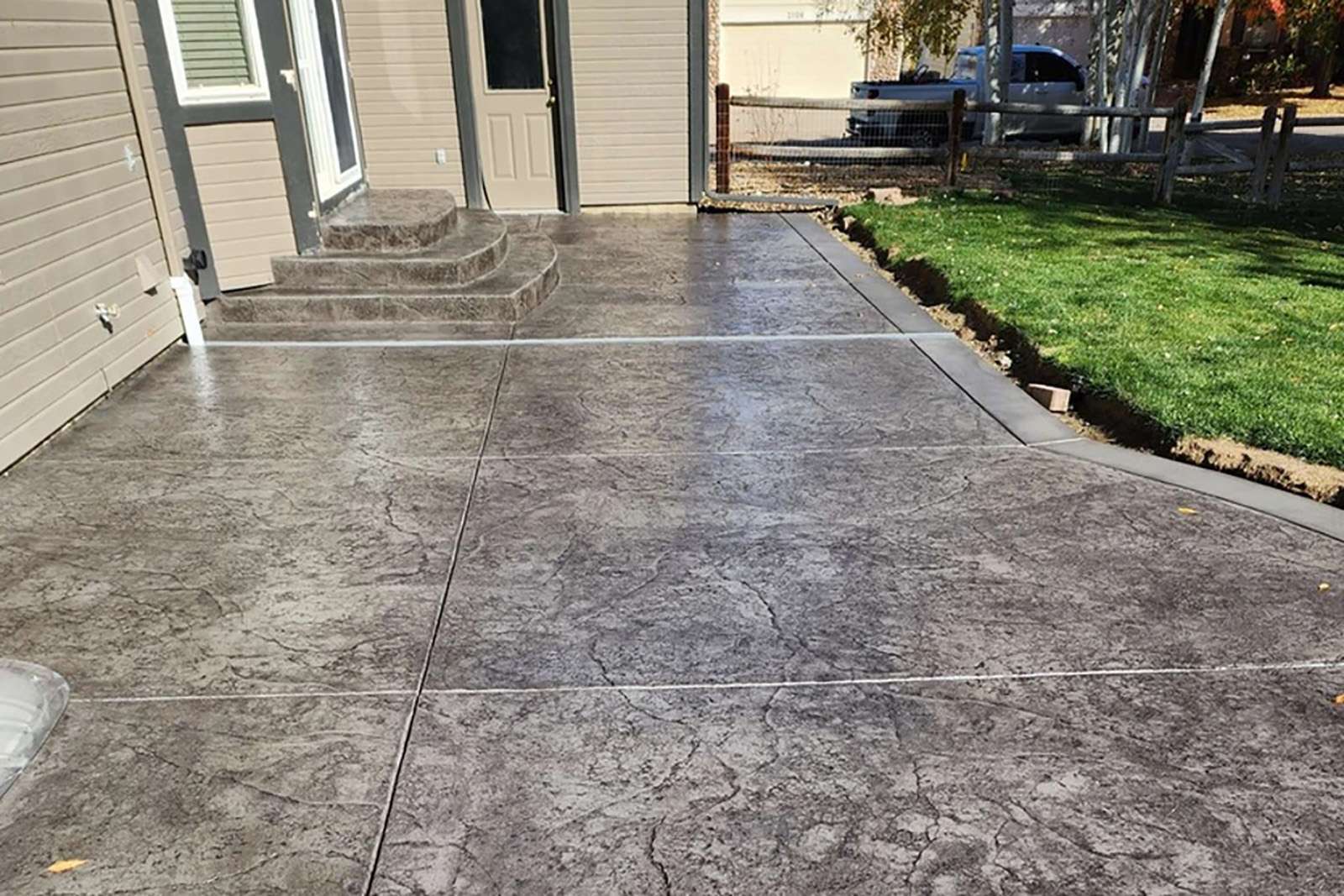
What a stamped concrete project includes
A stamped concrete project is a short list of decisions made before the forms go in, then one pour that has to execute all of them at once. Here is what we settle with you first.
- Pattern family. We stamp ashlar slate, wood plank, running bond, and cobble. Ashlar slate is an irregular stone layout that hides small variation well and stays forgiving on a big open slab. Wood plank reads as long boards and wants a straight run to look right. Running bond is a tight rectangular brick layout with a strong direction to it. Cobble is small, rounded, and busy, which suits a border or a compact area better than a wide field.
- Integral color and release color. Integral color is added to the concrete so the tone goes all the way through, which is why a chip or a saw cut later shows the same color rather than gray underneath. Release color is the powder broadcast across the surface immediately before stamping. It keeps the mats from sticking, and it settles into the low points of the texture, giving the finished surface its second tone and its depth.
- Joint layout. Control joints are cut or tooled so the slab cracks where we told it to instead of where it wants to. On stamped work those joints have to do that job and disappear into the pattern at the same time, so we lay them out against the pattern lines, the slab shape, and sensible panel sizes rather than dropping a grid on top of the drawing.
- Edge and border detail. A border is a band around the perimeter in a different pattern, a different color, or both, and it is the most visible upgrade available on a stamped slab. It also gives the crew a clean line to stamp to. Steps, a radius, and any transition to an existing surface get detailed here as well.
- What is underneath. A stamped surface is only as good as the slab carrying it, and the slab is only as good as what it sits on. That means a stripped and compacted subgrade, a base course brought to grade, positive slope away from the house, reinforcement sized to the slab, and full thickness held all the way out to the edges, where most failures start.
What does a stamped concrete project cost?
We price every stamped slab off the drawing, not off a rate card, and 5 things move the number more than anything else.
| What Drives the Number | Why It Moves | What We Do About It |
| One pattern, or a pattern plus a contrasting border | A border is a second pattern, usually a second color, and a second set of stamping passes on a slab that is already on the clock. It adds layout time before the pour and crew time during it. | We quote the border separately from the field, so you can see what that choice costs and decide, rather than getting one number and guessing. |
| One color, or two | An integral color on its own is a single decision. A contrasting release, or a different color running in the border, adds material, adds a step during the tightest part of the pour, and raises the cost of getting it wrong. | We put the combination in front of you on a sample before anything is ordered, so nobody is judging color off a screen. |
| Slab size and shape | A large simple rectangle stamps efficiently. The same square footage broken into narrow runs, curves, and corners takes far more forming, far more layout, and more mats worked by hand along the edges. | We look for a shape that gives you the space you want with fewer awkward stamping edges, then quote the shape we agreed on. |
| Site access for equipment | Stamped work is time critical, so access turns directly into cost. A gate that will not pass equipment, a long carry from the street, or a tight back yard means concrete is moved by hand and the crew reaches the stamping window slower. | We walk the access route at the estimate instead of discovering it on pour day, and we staff the pour for the access we actually have. |
| Removal of existing flatwork | Old concrete has to come out and go somewhere before anything new goes in. Its thickness, whether it holds reinforcement, and how far it has to be carried all move that line. | We measure the existing slab at the estimate and quote removal on its own line, so it is never buried inside the cost of the new work. |
The reason we do not publish a square foot figure is that none of the rows above hold still, and a number that ignores them is a number you would have to renegotiate later. What you can compare between contractors is the specification: slab thickness, the mix, the reinforcement, the joint plan, whether a border is included, and what happens to the old concrete. Ask every bidder for those six items in writing and the quotes stop looking arbitrary.
How we run a stamped concrete project
A stamped pour is planned backward from the stamping window. Everything before it exists so the crew reaches that window ready.
- Subgrade and base. We strip organics and soft material, shape the subgrade to follow the finished slope, and compact it. A base course then goes down, brought to grade and compacted in turn. This is the least visible step on a stamped concrete project and the one that decides how the slab behaves in year five.
- Forms and reinforcement. Forms are set to the finished elevation and staked, radii are bent in, and the perimeter is checked for slope so water leaves the slab instead of ponding in the texture. Reinforcement goes in on chairs so it sits inside the slab rather than on the ground beneath it.
- Pour and screed. Concrete is placed in a continuous run and screeded to grade. A stamped slab is poured to full depth across its whole area, edges included, because a thin edge breaks first and a broken edge on a patterned surface is not something anyone can hide.
- Float and color. The surface is bull floated to close it and bring up the paste the mats will read. Once the bleed water is gone and the slab has begun to firm, release color goes down across the area about to be stamped.
- The stamping window. Mats are laid in the planned sequence and tamped, starting from a fixed reference line so the pattern stays square across the whole slab and does not drift. The crew works in a line and does not stop, because a slab that stiffens mid run leaves a visible seam between what was stamped early and what was stamped late. This is the step everything else was scheduled around.
- Tooling the joints. Control joints are cut or hand tooled into the layout we drew, timed so the slab has taken enough set to hold a clean edge but not so late that it has already relieved itself somewhere we did not choose.
- Cure. The slab is kept damp and protected while it gains strength. Curing is slow and unexciting, and it is the difference between concrete that reaches its designed strength and concrete that merely went hard.
Where we work
We pour stamped concrete in Fort Collins, Laporte, Wellington, Timnath, Windsor, Loveland, Berthoud, Greeley, Evans, Johnstown, Milliken, Mead, Longmont, Frederick, Erie, Boulder, Broomfield, Thornton, Brighton, and Commerce City. The service area matters more on this kind of work than it does on a plain slab, for a simple reason: once concrete is on the ground, the crew cannot leave it. A stamped pour is a whole day committed to one address, staged the day before, with the crew on site from placement through the last mat. We schedule it that way deliberately instead of stacking two stamped pours against each other and hoping both windows behave.
Weather is the other reason we plan by town rather than by region. A hot windy afternoon in Greeley and an overcast morning in Fort Collins are different pours, and the same mix with the same crew will hit the stamping window at different times in each. We watch the forecast for your address in the days beforehand, and we would rather move a stamped pour by a day than press a mat into a slab that is not ready for it.
If your town is on that list and you are weighing a stamped patio, walkway, or entry, we will come look at the space and give you a free estimate. There is no charge for the visit and no obligation after it.
Get a Professional Free Estimate
Estimates are free. Call ECB Concrete LLC at (970) 880-3330 or email ecbconcrete@gmail.com, tell us roughly what area you are looking at and where it sits, and we will set a time to come see it.
What helps most on the visit: a rough idea of the size and shape you want, where you want the slab to stop, and any pattern or color you have seen and liked. Photos are useful, even bad ones. From there we walk the access, look at what is on the ground now and what has to come out, check where water runs, and put a written number in front of you against a written specification, so you know what the slab is and not only what it costs.
We are a family owned, father and son crew pouring residential concrete out of Fort Collins, and stamped concrete is work we would rather do properly on a schedule that respects the weather than quickly on one that does not.
Frequently Asked Questions
Will a stamped concrete pattern survive Colorado freeze and thaw?
The pattern survives as long as the slab does, because the texture is the concrete itself rather than a layer laid over it. There is nothing on top to peel or wear through. What freeze and thaw actually attacks is water: water that sits in the texture or soaks into a poorly consolidated slab, freezes, expands, and works the concrete apart from the inside. That is why we care so much about slope, about full thickness at the edges, about 4000 PSI concrete rather than a weaker mix, and about where the joints fall. Get the water off the slab and out from under it, and the pattern you see in year one is close to the pattern you see in year ten. Color softens some, the way any exterior surface does, and the high points of the texture take the traffic and lighten first. Neither of those is failure. A cracked, heaved slab is failure, and that gets decided underneath, not at the mats.
Can you stamp a pattern into the concrete I already have?
No. Stamping happens to plastic concrete, in the hours between placement and set, and a slab that went hard years ago cannot be given a pattern now. When someone wants a patterned surface where a plain slab sits today, our answer is to take the old concrete out and pour new. That is a real cost and we would rather say it plainly at the estimate than propose something that will not hold up. It also means the new slab gets the base, the thickness, the reinforcement, and the joint layout a stamped surface needs, which a slab poured years ago for a different purpose almost never has.
How do I pick a pattern scale for a small area?
Match the size of the repeating unit to the size of the slab. A large format ashlar slate on a small landing gives you two and a half stones and reads as an accident, while a small cobble across a wide open slab turns into visual noise the eye cannot rest on. The guideline that holds most of the time: small areas want a smaller unit, or a pattern with a strong direction, like a wood plank run lengthwise, which makes a narrow space read longer. Large areas can carry a big irregular pattern, and they benefit from a border to give the field an edge. We lay the mats out on the drawing before we agree on a pattern, so you can see how many full units land inside your actual dimensions.
Where do the control joints go in a stamped slab?
Where the slab needs them first, and where the pattern can hide them second. Concrete shrinks as it cures and it will crack somewhere; a control joint is a weakened line that decides where. Spacing comes off slab thickness and shape, and every inside corner is a place a crack wants to begin, so a joint usually runs out of one. On stamped concrete we then hunt for a pattern line the joint can follow, a grout line in the ashlar, a plank seam, the inside edge of a border, so the joint disappears into the texture. When the two cannot be reconciled, the slab wins and the joint goes where the slab needs it. A joint you can pick out is a far smaller problem than a random crack running across a pattern.
How does stamped concrete compare with pavers?
They age and fail differently, and that is the honest basis for choosing between them. Pavers are individual units bedded on a compacted base, so they move with the ground, they can be lifted and reset, and a single damaged unit can be swapped out. They also have joints everywhere, which is where sand washes out and growth starts, and a paver field can settle unevenly over time. A stamped slab is one monolithic piece, so it has no joints to wash out and nothing to shift out of line, and it can carry patterns and color transitions no paver catalog offers. The tradeoff is that a slab is a single object: what happens to it happens to all of it, and a badly failed slab gets replaced rather than picked apart. If your ground is stable and you want an unbroken surface, the slab is the stronger choice. If you expect to open the ground later for something running underneath it, pavers are easier to live with.