
Colored Concrete in Fort Collins and Northern Colorado
Colored concrete gets its color one of three ways, and which way you choose matters more than the swatch you point at. Pigment can be mixed through the entire batch before the concrete is delivered, so the color runs the full depth of the slab. It can be applied as a dry hardener that the finisher works into the top layer while the surface is still open. Or it can arrive as a release agent, cast across the surface right before a texturing tool presses into it. Same word on the estimate, three different materials, three different ways the color behaves twenty years from now.
ECB Concrete LLC is a family-owned, father-and-son residential concrete contractor in Fort Collins, pouring colored flatwork for homeowners across Northern Colorado. We would rather spend twenty minutes on the color system with you at the estimate than have you find the difference after the slab has cured. Color is one of the few decisions on a concrete project that cannot be revised later. Forms can be adjusted. A joint layout can be redrawn on site. A finish can change the morning of the pour. The color goes in at the plant, or into the surface during a window of about an hour, and after that it is the color you live with.
What follows is how each color system works, what changes when the same pigment is applied over a different finish, and why two slabs poured from the same order can read slightly differently in the same yard.
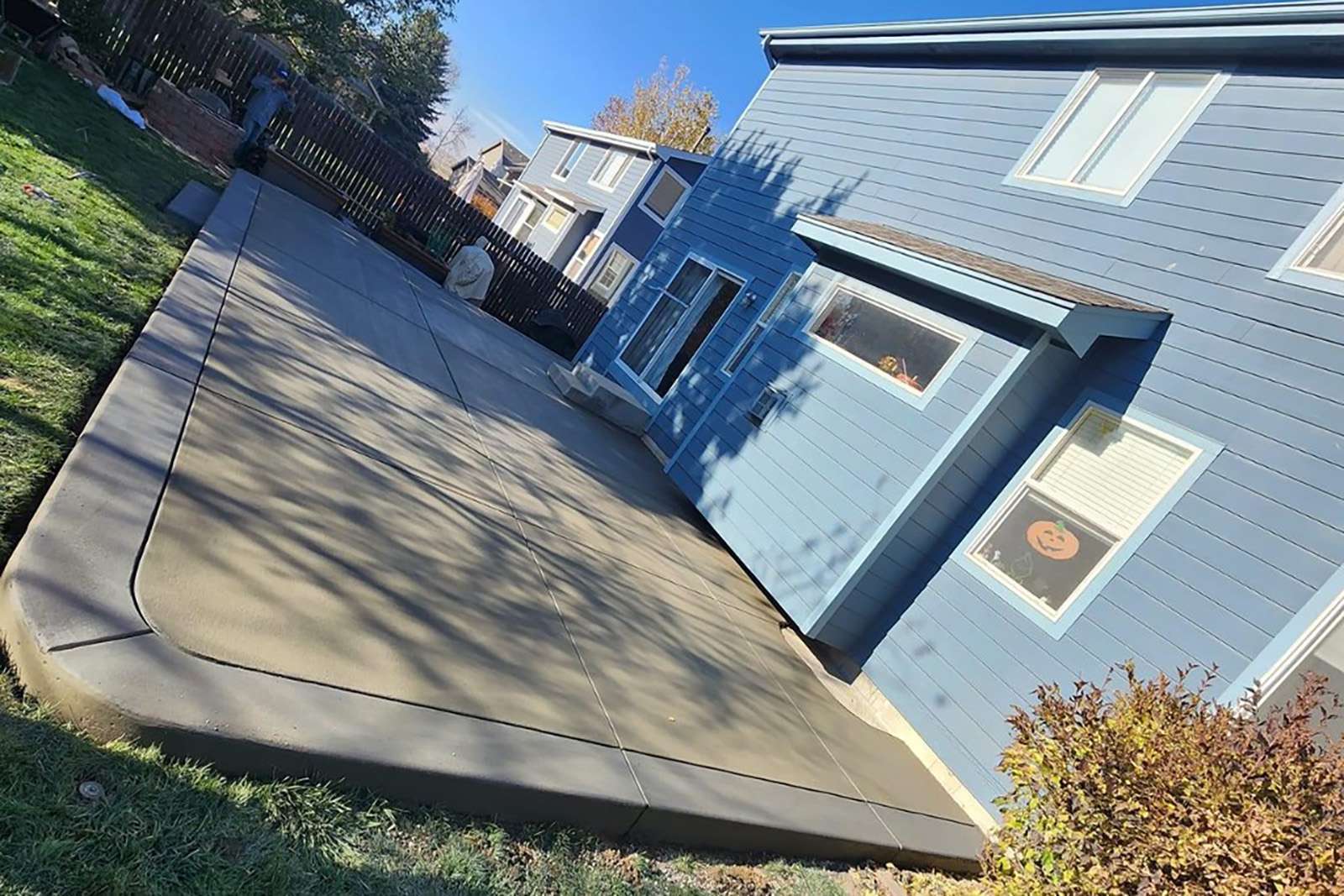
What a colored concrete project includes
A colored concrete project is a normal flatwork pour with one extra decision layered onto it, and that decision touches the order, the finishing window, and the sign-off. Here is what we cover on ours.
- Integral color through the mix. The pigment is added to the concrete at the plant, so every cubic yard on the truck carries color all the way through. Integral color is the most forgiving option over a long life: when the surface eventually wears, what shows underneath is the same color rather than gray. It reads softer and a shade lighter than a hardener in the same tone, because the pigment is spread through the whole volume instead of concentrated at the top.
- Color hardener at the surface. Dry shake hardener is broadcast onto the fresh slab and floated into the top layer. It gives a denser, harder-wearing surface and a noticeably richer color than the same pigment used integrally, because all of it lives in the top eighth of an inch. The trade-off is depth. A chip or a heavy scrape reaches the gray underneath it.
- Release color during texturing. When a pattern is being pressed into the surface, a release agent keeps the tool from sticking. Colored release does double duty, leaving a secondary tone in the low points of the texture so the finished surface carries variation instead of one flat note. It is an accent rather than the base color, and most of what does not settle into the texture washes off.
- A sample you sign off on before the pour. Color charts are printed. Concrete is not. We put the color in front of you on a real sample instead of a card, because pigment on paper and pigment in cured cement are two different things.
- Matching across separate pours or phases. A driveway poured this spring, and an extension poured next fall will not come off the same truck. We record the color, the dose, and the finish for the address, so a second pour starts from real numbers rather than a memory.
- How the finish changes the way a color reads. The same pigment looks darker under a broom finish, lighter and flatter under a hard trowel, and more varied under a texture. We choose the finish and the color together, never one and then the other.
What does a colored concrete project cost?
Color adds cost in 3 places: the pigment itself, the labor the finish demands, and the consistency work that makes separate pours read alike. We publish no prices, because the color system and the way the pour is sequenced move the number more than square footage does. What we can do is show you where the money actually goes.
| What Drives the Number | Why It Moves | What We Do About It |
| Integral color or color hardener | Integral pigment is priced into every cubic yard, so it scales with volume. Hardener is priced by the bag and by the labor of broadcasting and floating it, so it scales with surface area and with how deep the tone is. | We price both systems on the same slab when the two are genuinely in play, so you are comparing them rather than guessing. |
| One color or a second accent color | A second color means a second material, a second set of hands inside a short finishing window, and a layout that has to be right the first time. | We say plainly when an accent will read as a feature at your scale and when it will read as a mistake. |
| Sample panels before the pour | Samples take material and a separate trip. On a large area or an unusual tone they earn that back immediately. | We build them as a matter of course on colored work, rather than argue about a swatch afterward. |
| Matching an existing colored area | Matching is investigative work. The existing slab has aged, so the target is what it looks like now, not what it looked like new. | We tell you up front how close we expect to get, and we plan a joint or a break between old and new. |
| Pour size against the number of loads | Color is dosed per cubic yard, and every additional load is another opening for small variation. A job that fits one delivery reads more evenly than the same job split across three. | We size and sequence the work so the colored pour lands in as few loads as the site allows. |
| The finish the color sits under | A broom finish is quick. A hard troweled or textured surface takes longer and takes more skill, and colored work leaves less room to correct a misstep. | We quote the finish and the color as one line, because pricing them apart hides the labor. |
Two slabs of the same size can land far apart because one is integrally colored under a broom finish and the other is a hardener under a texture with an accent release. When we walk your project, we will tell you which row above is doing the most work on your number.
How we run a colored concrete project
The order below is the order it happens in on site. Two of these steps have no equivalent on a plain gray pour, and both of them sit early.
- Color selection and a sample. We start here, before anything is scheduled. You pick a direction from the manufacturer’s range, we make a sample in the finish you want, and you look at it outdoors in daylight rather than under a garage bulb. Nothing gets ordered until that is settled.
- Base and forms. Excavation to grade, a compacted base, then forms set to the lines and slopes the site needs. Color does not change this step, but it raises the price of getting it wrong: a slab you have to take out is a color you then have to match.
- The color goes on the order. We specify the pigment and the dose per cubic yard when the concrete is ordered, and the color is added at the plant before the truck loads. Ordering the whole job at once, where the pour size allows it, does more for consistency than anything else on this list.
- Pour and screed. The concrete is placed, screeded to grade, and bull floated. On an integrally colored slab, the color is already locked in by this point. On a hardener slab, this is the surface being prepared to receive it.
- Hardener or release, where the design calls for it. Color hardener is broadcast in two passes and floated in, the second pass covering anything the first missed. If the slab is being textured, release goes down immediately ahead of the tool. This window is short, and it does not reopen.
- Finishing. Edging, then the surface finish you chose back at step one. The finisher watches the slab rather than the clock, because a colored surface worked too early or too late shows it more plainly than gray does.
- Joints. Control joints are cut on a layout we set before the pour and sized to the slab. On colored work, the joint pattern is a visible design line, so we lay it out to look deliberate instead of convenient.
- Cure. The slab is kept damp and covered through its early cure. Colored concrete is more sensitive here than gray is: uneven drying is one of the more common reasons a finished slab shows blotching that had nothing to do with the pigment.
Where we work
We pour colored concrete for homeowners throughout our service area: Fort Collins, Laporte, Wellington, Timnath, Windsor, Loveland, Berthoud, Greeley, Evans, Johnstown, Milliken, Mead, Longmont, Frederick, Erie, Boulder, Broomfield, Thornton, Brighton, and Commerce City.
The color question itself barely changes from town to town. What changes is the logistics behind it. A longer haul from the plant delivers concrete in the same condition as a short one only when the delivery is planned that way, and on colored work that planning earns its keep. We schedule colored pours so the whole job, or at least a whole visible section of it, lands in one continuous placement wherever the site allows.
We also keep the color record by address. Do the patio this year and the walkway next year, and the second job does not start from a photograph.
If your town is on that list, estimates are free. Call (970) 880-3330 or send the project details to ecbconcrete@gmail.com, and we will get you one.
Get a Professional Free Estimate
Bring us the color question early. The most useful conversation we have with a homeowner about colored concrete happens before anything is ordered, while integral color, a hardener, and a colored release are all still on the table and the finish is still open.
Everything we pour is 4000 PSI concrete or better, colored or gray. Color changes how a slab looks over the next few decades. It does not change what the slab is made of.
Estimates are free. Call (970) 880-3330, email ecbconcrete@gmail.com, or reach us through the site. If you are still weighing what kind of flatwork you want, our concrete services page lays out the rest of what we pour.
Solid Foundations, Lasting Impressions.
Frequently Asked Questions
Does colored concrete fade?
Not the way paint fades. The pigments used in concrete are mineral oxides and they are chemically stable in cement. What homeowners usually see and call fading is one of three other things. Efflorescence is the most common: moisture moving out through the slab carries dissolved minerals to the surface and leaves a faint white haze that mutes the color. It comes and goes with the seasons and generally eases off over the first couple of years. The second is surface wear, and this is where the two systems part ways, because a worn integral slab exposes more of the same color while a worn hardener exposes gray. The third is plain dirt. A slab nobody has washed in five years has not lost its color.
Why do two areas of the same color look slightly different?
Because concrete is finished in the field and small variables stack up. Pigment is dosed per cubic yard, so two loads can sit a fraction apart. Water content differs slightly load to load, and more water cures out lighter. One area gets worked a few minutes earlier than another, so the surface closes at a slightly different moment. Sun on half a slab dries it faster than the shaded half. None of these are defects, and none of them can be engineered away the way a factory tile is. Variation is part of how colored concrete reads, which is also why a colored release is often used to lean into it rather than fight it.
Can a driveway come out without tearing up the lawn and the sprinkler system?
Usually yes, and it is a planning question rather than a luck question. Sprinkler heads and valve boxes get located and flagged before anything moves. The machine gets one defined path in and out, so tracking is confined to a single line instead of spread across the yard, and mats or plywood go down where the ground is soft. Irrigation lines running underneath the slab itself are the exception. If a line crosses concrete that is being broken, it has to be dealt with, and we would much rather find it on the walk-through than with a breaker. Anything staying, including the apron at the street, gets a saw cut so the break stops where we want it to.
Can ECB match an existing colored slab?
We can get close. We cannot promise exact, and anyone who does is guessing. The existing slab is no longer the color it was poured as. It has weathered, worn, collected dirt, and probably passed through an efflorescence cycle or two. Even with the original color name and dose in hand, a fresh pour beside it starts where that slab started years ago, not where it sits today. So we take the honest route: sample against the real slab in daylight, pick the closest system, and set a control joint or a deliberate break between old work and new so the eye reads two areas instead of one bad seam. Where the old work is far enough gone, replacing the whole area beats chasing a match.
Does adding color make the slab weaker?
No. Integral pigment is an inert mineral oxide dosed at a small percentage of cement weight, and at that dose it does not meaningfully change the mix. Dry shake hardener runs the other direction: it adds cement and hard aggregate to the top layer, so the wearing surface finishes denser than a plain one. Our slabs are 4000 PSI concrete whether they are colored or gray. What decides whether a slab holds up is the base under it, the thickness, the joint layout, and the cure, and none of those shift because there is pigment in the mix.
How much does the finish change the way a color reads?
More than most people expect, often more than moving a step on the color chart. A broom finish scatters light across thousands of small ridges, so it reads darker and more matte. A hard troweled surface is smooth and reflective, so the same pigment looks lighter and a little cooler. A texture creates highs and lows, so the color reads as a range instead of a single tone, especially with a colored release sitting in the low points. That is why we sample in the finish you are actually getting, not a convenient one.
For a driveway, is integral color or a color hardener the right call?
On a driveway we usually lean integral, and the reason is wear rather than looks. A driveway takes tire scrub, turning wheels, shovels, and plow blades. Integral color absorbs that wear because the color continues down through the slab. A hardener gives a richer tone and a tougher surface, but its color lives in the top eighth of an inch, so a deep gouge shows gray. Some homeowners want the richer tone enough to accept that, and it is a fair trade to make with your eyes open. We put both in front of you on samples and let you decide.