
Concrete Contractor in Wellington, CO
In Wellington, the approval that decides whether a patio gets poured usually comes from a homeowners association rather than from the Town. Buffalo Creek’s association publishes an Architectural Review Committee and a Project Approval Form, along with approved paint palettes and a xeriscaping section, so exterior work there is reviewed in writing before it is built.
That is not how the rest of this corridor is set up. New neighborhoods around here are commonly run by metro districts. The state’s special districts dataset returns only two across the Wellington area, and Sage Meadows is marketed on having “No Metro Tax District”. What this town has instead is conventional subdivision associations with real architectural control, running about $95 a month in Sage Meadows and about $42 a month in Wellington Downs, both including non-potable irrigation water.
ECB Concrete LLC is a family owned business, father and son, working out of Fort Collins roughly ten miles down Interstate 25. Residential flatwork is the whole of what we do, and the estimate is free.
Ownership here is close to total. 80.8 percent of occupied homes are owner occupied and 86.4 percent of the housing is detached single family, across 4,170 households packed into 3.63 square miles and a single ZIP code, 80549. Almost everyone reading this owns the ground in question outright.
Most of the work follows from how new the town is. The median home was finished in 2010, 82.4 percent of the stock went up in 2000 or later, and 50.3 percent of it since 2010. The older pool is real but small. Roughly 743 homes predate 2000, and the Town’s own Housing Needs and Affordability Assessment places them “especially in the north central neighborhoods.”
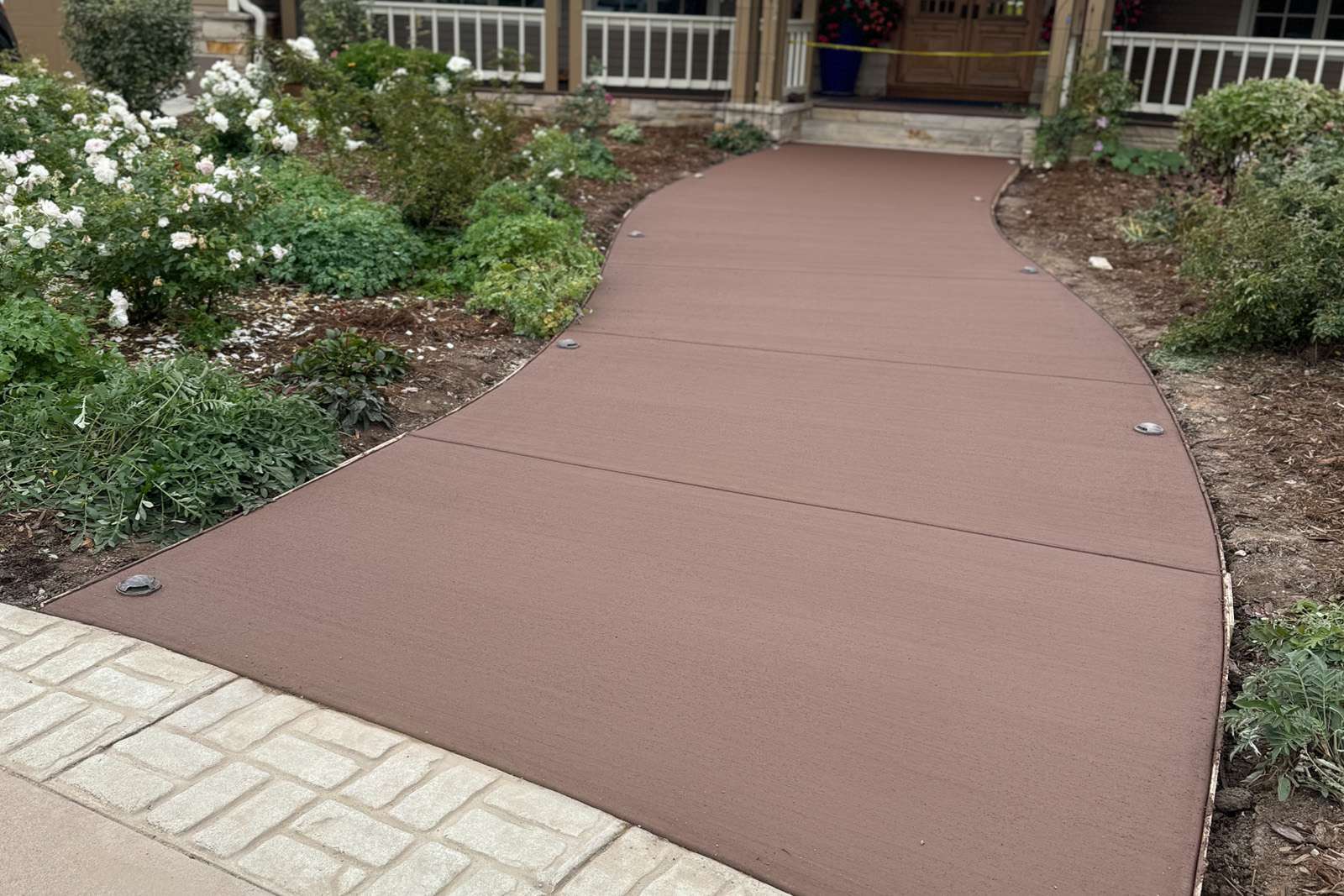
Concrete work we do in Wellington
Nearly everything on this list lands either on a lot that was handed over graded and bare, or on flatwork that has gone past the point of being worth keeping.
- Back patios, and extensions onto the small slab a builder left behind
- Walkways, side yard access strips and paths out to a gate
- Driveways, driveway widening and extra parking pads
- Stamped concrete, and colored or decorative finishes
- Steps and stoops
- Garage floors, basement floors, shed and pole barn floors
- Hot tub pads, shed pads, and RV or trailer pads
- Residential foundations
- Full removal of failed concrete and a fresh pour in its place
With 86.4 percent of the town’s 4,210 housing units being detached single family, that covers most of what an address here can actually use.
Every mix we place is 4000 PSI concrete or better, which counts for more on this ground than it would in a milder place. The estimate is free. Call (970) 880-3330.
Wellington permits and local details
Two approvals can stand between a homeowner here and a finished slab, and the Town owns only one of them.
The association is usually first, and in most of this town it is the only one in play. Buffalo Creek publishes an Architectural Review Committee and a Project Approval Form, plus approved paint palettes and a xeriscaping section, which is an unusually engaged level of architectural control for a place this size. Sage Meadows runs about $95 a month covering a pool, clubhouse, community park, walking trails and non-potable irrigation water. Wellington Downs runs about $42 a month, non-potable irrigation included. Dues differ and so does the scrutiny, so your covenants decide this, not the Town and not a contractor. Read them before settling on a shape, a finish or a color.
That irrigation water is also why back yards in these subdivisions are genuinely landscaped and used, which is what turns a graded rectangle into a patio enquiry at all. Wellington Community Park sits inside the same north end of town, on Buffalo Creek Parkway.
The Town’s side is narrower than most people expect. Wellington adopted the 2024 International Codes effective January 1, 2026, and its local amendments, Ordinance No. 15, 2025, rewrite only three exceptions in the residential code’s work exempt from permit list: detached accessory structures, fences and shingle repair. The model exemption covering sidewalks and driveways is left as written. The Town’s homeowner permit page confirms it by omission. That page names additions, alterations, accessory structures, basement finishes, pergolas and patio covers, sheds of any size, generators, gas lines, fire pits, fireplaces, swimming pools and hot tubs, and it never lists concrete flatwork, driveways, patios or slabs anywhere on it.
Put a roof over the slab and the answer changes. Pergolas and patio covers are on the permit list, which is worth knowing while a patio is still being laid out rather than after. Plan review, permits and inspections run through SAFEbuilt as the Town’s building department partner. The Town also states that it “requires all Contractors and Sub-contractors working in the Town of Wellington to hold current Contractor Licenses prior to applying for Building Permits.”
On footing depth the Town and the County agree, and both are citable. Larimer County’s structural design criteria set a minimum frost depth of 30 inches below grade countywide, and Ordinance No. 15, 2025 amends the building code to state the same 30 inches. Anything carried on a pier has to reach it.
Under the town, the USDA soil survey maps six series in its high shrink swell band, which runs from 6 to 9 on the linear extensibility scale. Heldt clay loam reaches 8.0 with 45 percent clay. Longmont clay sits at 7.5 with 50 percent clay straight through the profile, offering no relief at sub base depth. Weld silt loam reaches 7.7, Ulm and Renohill clay loams 7.5, and Nunn clay loam, one of the most widespread series mapped here, runs 6.6 to 7.3. The Colorado Geological Survey states that expansive soils “can expand up to 20% by volume when exposed to water and exert a force of up to 30,000 pounds-per-square-foot”, and lists “cracked driveways, sidewalks and basement floors” as the signature damage.
The same Survey is explicit that only a qualified soil engineer should identify that hazard on a given lot, so nobody should be diagnosing your yard from the curb, us included. What a contractor does control is the response: sub base compacted and drained, water carried away from the edges, thickness and reinforcement matched to the load, and joints cut before the slab decides on its own where to crack.
The town sits at 5,194 feet on open plain with no foothills shelter, and no station in it carries a 1991 to 2020 NOAA normal. The two nearest that do bracket this part of Northern Colorado at 143.7 and 157.0 days a year when the surface passes through the freezing point inside a single day. Both run above the 134.6 the same method gives for Fort Collins proper. The pour window is narrow to match: normals show zero freezing nights across June, July and August, 1.8 in May and 0.7 in September, then 11.4 in October and 13.0 in April. Larimer County’s design criteria put minimum basic wind speeds between 115 and 225 mph with Exposure C as the default, which is the code’s way of describing an exposed plain. Wind and dry air at altitude pull moisture out of fresh concrete fast, and that is a finishing and curing problem rather than a weather inconvenience.
Get a free estimate in Wellington
The estimate is free. Call ECB Concrete LLC at (970) 880-3330, or email ecbconcrete@gmail.com, and say what you are looking at.
We are family owned and father and son operated, based in Fort Collins and pouring residential concrete across Northern Colorado, Wellington included. Every slab we place is 4000 PSI concrete or better.
If your subdivision runs an architectural review, reading what it asks for is time well spent before a design is settled. Buffalo Creek publishes its Project Approval Form openly, and knowing what a committee wants to see changes the conversation early rather than late.
Custom Concrete Services
Our Custom Concrete Service covers all of your concrete needs.
We have over 20 years of experience providing all concrete services including:
Concrete Driveways & Sidewalks
Other areas we serve
ECB Concrete pours residential concrete across Northern Colorado. From here, Fort Collins is about ten miles south on Interstate 25, with Laporte, Timnath and Windsor beyond it.
We also work in Loveland, Greeley, Berthoud, Johnstown and the rest of our Northern Colorado service area. The same 4000 PSI concrete goes into every one of them, and the estimate costs nothing wherever you are. Call (970) 880-3330.
Get a Professional Free Estimate
Send us the drive and walk dimensions, a note about what parks on the surface, and a couple of photos showing how the existing concrete has failed. That is usually enough for us to tell you what the scope should be.
Estimates are free. We will walk the site, shoot the grades, and give you a written scope that names slab thickness, base depth, and reinforcement, so you can hold it against anything else you have been quoted.
ECB Concrete LLC (970) 880-3330 ecbconcrete@gmail.com 3717 S Taft Hill Rd #161, Fort Collins, CO 80526
We are fully licensed and insured, and every concrete driveways and sidewalks quote we write is an itemized scope you can read line by line before you decide anything.
Frequently Asked Questions
Our subdivision has an architectural review committee. Does that come before the Town?
In most of this town it is the only approval in play. Buffalo Creek’s association publishes an Architectural Review Committee and a Project Approval Form, so exterior work there is submitted and approved in writing before anything is built. The Town’s own homeowner permit page never names concrete flatwork, driveways, patios or slabs, so for a plain slab there is usually nothing to pull from the Town at all. Your covenants are the document that settles it, and they differ from one subdivision to the next.
Our house is in the north central part of town and the concrete is original. Is that unusual here?
It puts you in a minority of roughly 743 homes. Only 17.6 percent of the housing stock predates 2000, and the Town’s Housing Needs and Affordability Assessment places the older homes “especially in the north central neighborhoods”, around the original townsite near Centennial Park. Lots there are narrower and access is tighter than in the newer subdivisions, so the job is genuine tear out and repour rather than adding something to a bare yard.
How deep do footings go for anything we set on top of a patio?
30 inches. Larimer County’s structural design criteria set a minimum frost depth of 30 inches below grade countywide, and Ordinance No. 15, 2025 amends the building code to say the same thing. A slab on grade does not need that depth. A pier carrying a pergola or a patio cover does, and those covers sit on the Town’s permit list while the concrete under them does not.
Our HOA supplies non-potable irrigation water. Does that matter next to a new slab?
It matters, because water is what wakes expansive clay up. The Colorado Geological Survey states that expansive soils “can expand up to 20% by volume when exposed to water”, and six soil series mapped under the town sit in the USDA high shrink swell band. Non-potable irrigation is a standard amenity in Buffalo Creek, Sage Meadows and Wellington Downs, which is why back yards here are watered and planted. It also puts sprinkler heads, beds and grade right up against the concrete. Getting water to run away from the slab edge, and keeping it out of the sub base, is a decision made before the pour rather than after.
Half the town was built in the last sixteen years. Is our concrete too new to be worth doing anything about?
Usually too new to replace and often ready to be added to. 50.3 percent of the housing has gone up since 2010 and the median home was finished in 2010, so the original driveway and front walk on most lots still have service life left. What is missing is everything else: a patio larger than the slab the builder left, a walkway out to the gate, a pad for a hot tub or a trailer, and the extra parking a 2.83 person household ends up needing.